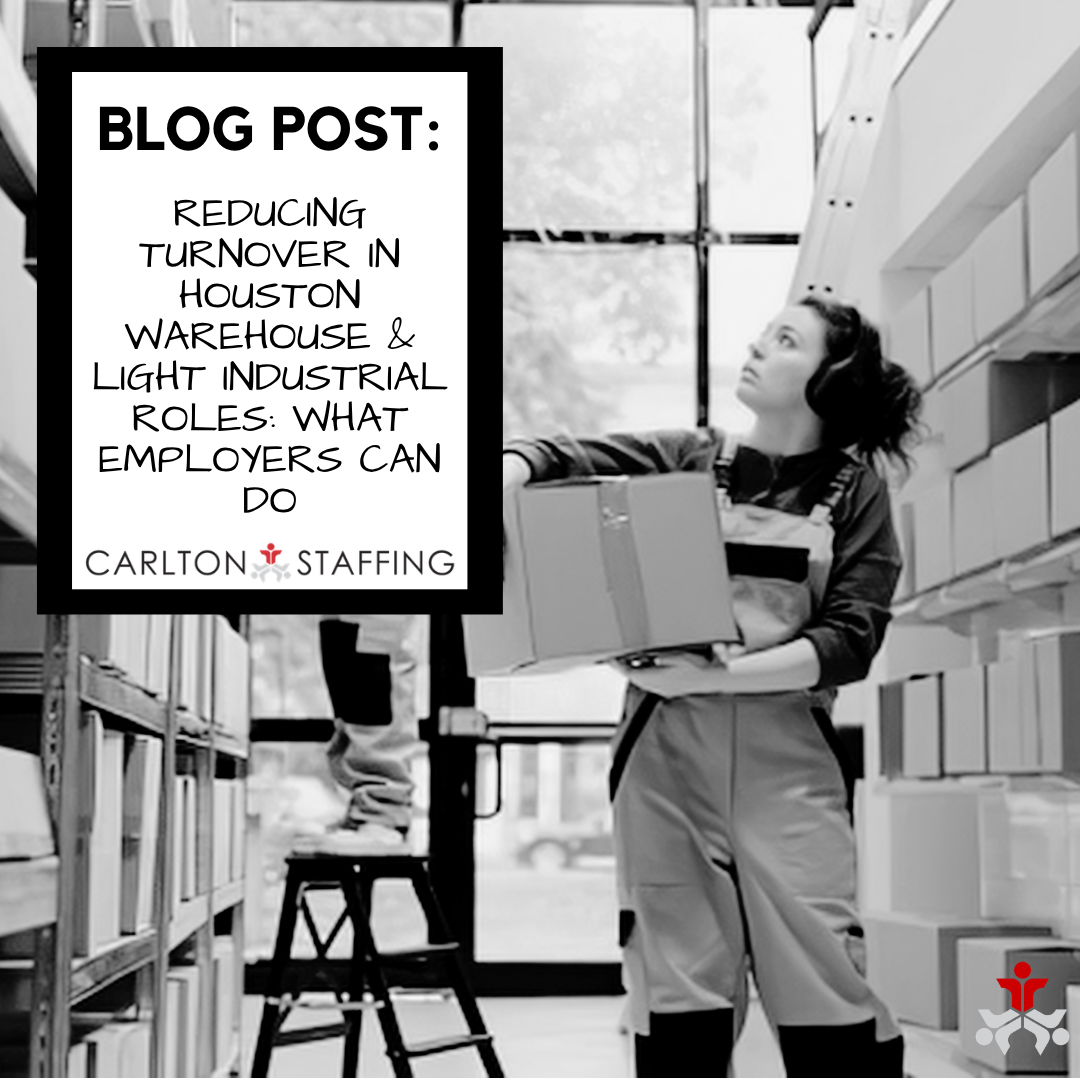
Reducing Turnover in Houston Warehouse & Light Industrial Roles: What Employers Can Do
If you run a warehouse, distribution center, or light manufacturing floor in the Houston area, you already know the number that keeps showing up on every ops review: turnover. Light industrial turnover has stayed stubbornly high across the region, and every employee who walks out the door costs real money in overtime, retraining, and lost productivity before a replacement is even fully up to speed. Reducing turnover in warehouse jobs isn’t about one fix — it’s a handful of specific, fixable gaps that most Houston employers can address starting this quarter.
Why Light Industrial Turnover Runs So High
A few patterns show up again and again when we talk with operations and HR leaders across Houston’s warehouse, logistics, and manufacturing employers:
Mismatched expectations at hire. A role sold as “steady, full-time work” that turns out to be unpredictable mandatory overtime loses people in the first two weeks. The mismatch, not the work itself, is usually what triggers the exit.
Slow or inconsistent onboarding. Workers who don’t feel competent and safe in their first few shifts are far more likely to no-show by week two. This is especially true in roles involving equipment, forklifts, or line work where early training quality matters.
Pay that falls behind the local market. Houston’s warehouse and light industrial pay rates have moved quickly over the past two years. An hourly rate that was competitive last year can quietly fall behind without anyone noticing until applications dry up.
Limited visibility into advancement. Workers who see no path from associate to lead, or from temp to permanent, are easier for a competitor down the road to poach with a few dollars more an hour.
What Employers Can Actually Do About It
Benchmark pay against the current Houston market, not last year’s. Rates for forklift operators, pickers/packers, assemblers, and general warehouse labor have shifted enough in the past 12-18 months that an annual (not semi-annual) check is worth the time.
Tighten the first-week experience. A structured first three shifts — clear expectations, a named point of contact, and real safety training rather than a video and a signature — measurably cuts early-stage attrition.
Use a temp-to-hire bridge deliberately. Temp-to-hire isn’t just a sourcing mechanism; it’s a two-way trial period. Employers who treat it that way (clear criteria for conversion, regular check-ins during the trial) convert a higher share of the workers worth keeping.
Build a visible path, even an informal one. Workers don’t need a full career ladder document — they need to know that there is one, and that people actually move up it.
Where a Staffing Partner Fits In
A lot of the turnover drivers above are solvable in-house with the right attention, but the hardest one for most internal teams to fix fast is the hiring pipeline itself: having a steady bench of pre-screened, reliable warehouse and light industrial workers ready when a line needs to scale up or a shift needs backfilling. That’s the piece a staffing partner is built to carry — screening for reliability and fit before someone shows up on shift one, and handling the temp-to-hire administration so your site leads can focus on running the floor rather than running job ads.
If your team is staffing up for seasonal peaks, backfilling a line, or just tired of the revolving door on a particular shift, Carlton Staffing works across Houston’s warehouse, distribution, and light manufacturing employers every week — browse current openings we’re filling at carltonstaffing.com/jobs/, see how employer partnerships work at carltonstaffing.com/employers/, or learn more about our team at carltonstaffing.com/about/.
If you’re hiring for warehouse, distribution, or light industrial roles in the Houston area, reach out to Carlton Staffing and let’s talk about what’s open on your floor right now.